Is Your 3 PM Slump a Coffee Problem or a Light Problem?
Your 3 PM crash isn't a coffee deficiency — it's a light problem. Caffeine lingers 6 to 8 hours, so the afternoon cup sabotages tonight's sleep. A caffeine curfew, morning daylight, and a 20-minute phone-free wind-down fix the loop.

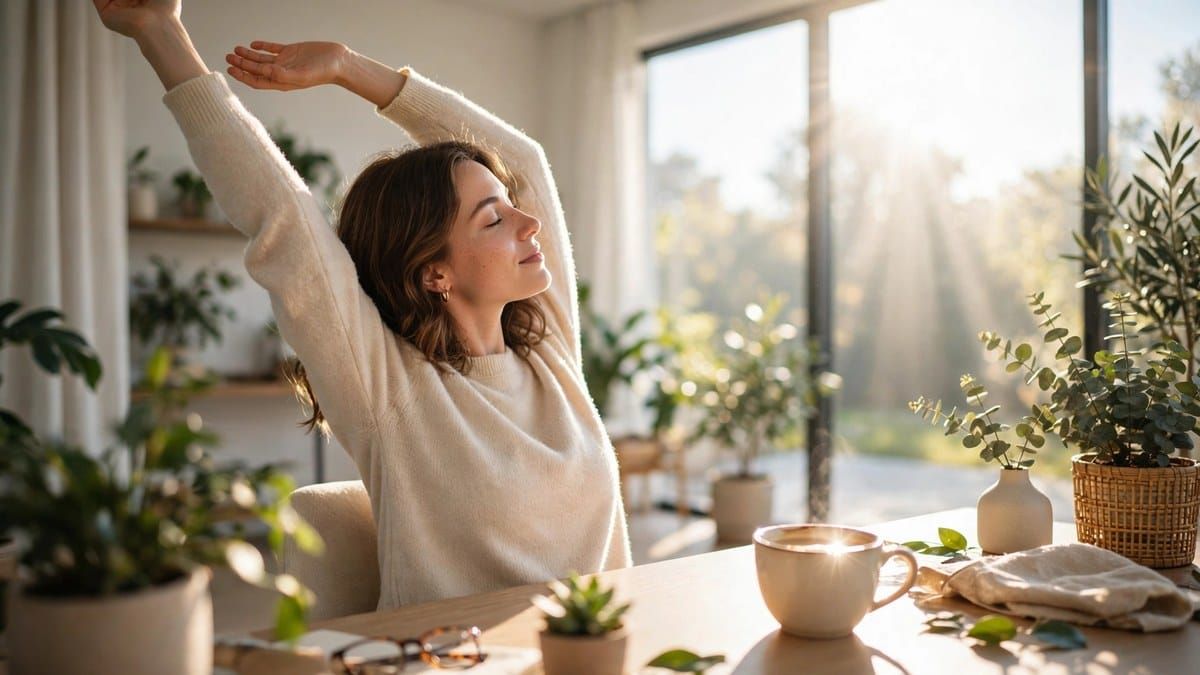
Is Your 3 PM Slump a Coffee Problem or a Light Problem?
That 3 PM crash isn't a character flaw, and it's probably not a coffee deficiency either. Before you reach for cup number three, consider what the NIH says about caffeine: it can linger in your system for 6 to 8 hours. Your 3 PM espresso is still in the driver's seat at 10 PM — quietly wrecking the sleep you'd need to fix the slump tomorrow.
The real culprit is usually light. Your brain reads brightness as time. Flood it with daylight in the morning and it sets your alertness clock. Starve it of light all day under office fluorescents, then blast it with blue light from your phone at midnight, and it has no idea when "day" is supposed to end. The slump is your clock, confused.
We can fix this without quitting coffee — by treating light like the signal it is.
This post contains affiliate links. If you purchase through our links, we may earn a commission at no extra cost to you. We only recommend products we've researched and would use ourselves.
Your caffeine has a curfew
Caffeine's half-life is roughly 5–6 hours, and the NIH's healthy-sleep guide notes it can affect you for 6 to 8 hours after that last sip. Do the math: a 3 PM coffee is half-strength at 9 PM. A 4 PM energy drink is still very much awake when you want to be asleep.
That creates a trap: bad sleep makes you tired, so you drink more afternoon caffeine, which makes sleep worse, which makes you more tired. The way out isn't zero caffeine — it's a cutoff. Move your last coffee to before noon (or at the very latest, 8 hours before bed), and the morning cup suddenly does more, because you're not fighting last night's residue.
Try this: pick one week. Last caffeine before noon, no exceptions. Track your 3 PM energy on a 1–10 scale each day. Most people are surprised by day four.
Light is the master switch
Light is the strongest signal your circadian system gets — stronger than meal timing, stronger than exercise. Here's the protocol researchers keep circling back to:
| Time | Do this | Why |
|---|---|---|
| Within 30 min of waking | Get outside for 5–10 minutes (even cloudy) | Daylight intensity dwarfs indoor lighting and anchors your clock |
| Midday | Work near a window if you can | Sustained bright light keeps afternoon alertness up |
| After sunset | Dim overheads, use warm lamps | Signals the brain that wind-down is coming |
| 1–2 hrs before bed | Cut blue light or block it | Blue light suppresses melatonin, the "it's night" hormone |
The evening step is where most people lose. Short-wavelength blue light from phones and tablets suppresses melatonin production, keeping the brain in a wakeful state even when the body is tired. A Livho High Tech Blue Light Glasses 2-pack is the practical fix when you can't put the screens away — wear them for the last hour or two of screen time. Check current price; they're one of the cheapest sleep upgrades that actually has a mechanism behind it.
And with the clocks falling back on November 1, this matters double. That extra hour of evening darkness is an opportunity — if your light hygiene is already in place, the transition is painless. If it isn't, it's another week of groggy mornings.
The 20-minute wind-down beats the perfect routine
Sleep researchers keep pointing to one change that shows up in better sleep surveys: a 20-minute wind-down with no screens before bed. Trading the phone scroll for a paperback, a short walk, or quiet music is now the single most-recommended first step — ahead of supplements, blackout curtains, and sleep trackers.
Why does something so small work? Most sleep disruption traces back to two things in the final hour: light exposure and mental alertness. The phone delivers both at once — blue light plus an endless feed designed to keep your brain activated. Removing it for 20 minutes removes both triggers in one move.
The practical trick: set a phone-away time, not a sleep time. Once the device is down, everything else tends to follow. Pair that dark, quiet window with a MZOO 3D Contoured Sleep Mask if your bedroom isn't truly dark — streetlight leakage through blinds is enough to fragment sleep. Check current price; with 100K+ reviews it's the value pick for a reason.
What to eat (and not eat) after dark
A October 2026 randomized trial found that eating almonds daily improved self-reported sleep quality, sleep efficiency, and time to fall asleep. A separate August 2026 study linked fiber-rich, plant-heavy diets to deeper, more restorative sleep. And dietitians this month keep landing on the same pre-bed drink: tart cherry juice with magnesium.
The pattern is clear: what you eat in the evening programs how you sleep. Keep dinner lighter and earlier, favor fiber and plants, and skip the late heavy meal. If a supplement fits your routine, Future Kind Magnesium Glycinate is the chelated, high-absorption form dietitians point to — check current price and talk to your clinician if you take other medications.
Our Top Picks
- Livho High Tech Blue Light Glasses 2-pack — Wear for the last 1–2 hours of screen time to stop blue light from suppressing melatonin. The cheapest mechanical sleep upgrade on this list. Check current price.
- MZOO 3D Contoured Sleep Mask — Zero-pressure contoured design that actually blocks light. 100K+ reviews. For bedrooms that never get truly dark. Check current price.
- Future Kind Magnesium Glycinate — Chelated, high-absorption magnesium in vegan capsules. The form dietitians keep recommending for the pre-bed routine. Check current price.
The Bottom Line
Your 3 PM slump is information, not failure. Set a caffeine curfew, get real daylight in the morning, block blue light at night, and give yourself a 20-minute phone-free wind-down. That's the whole protocol — and with the November 1 clock change coming, starting this week means you sail through it instead of suffering through it.
Read tomorrow's post on the evening reset that makes mornings automatic.