3 Protein + Fiber Breakfasts You Can Make Without Another Powder
Choose a make-ahead oat bowl, a hot egg-and-toast plate, or a no-cook yogurt plate. Each starts with ordinary groceries and equipment you may already own.

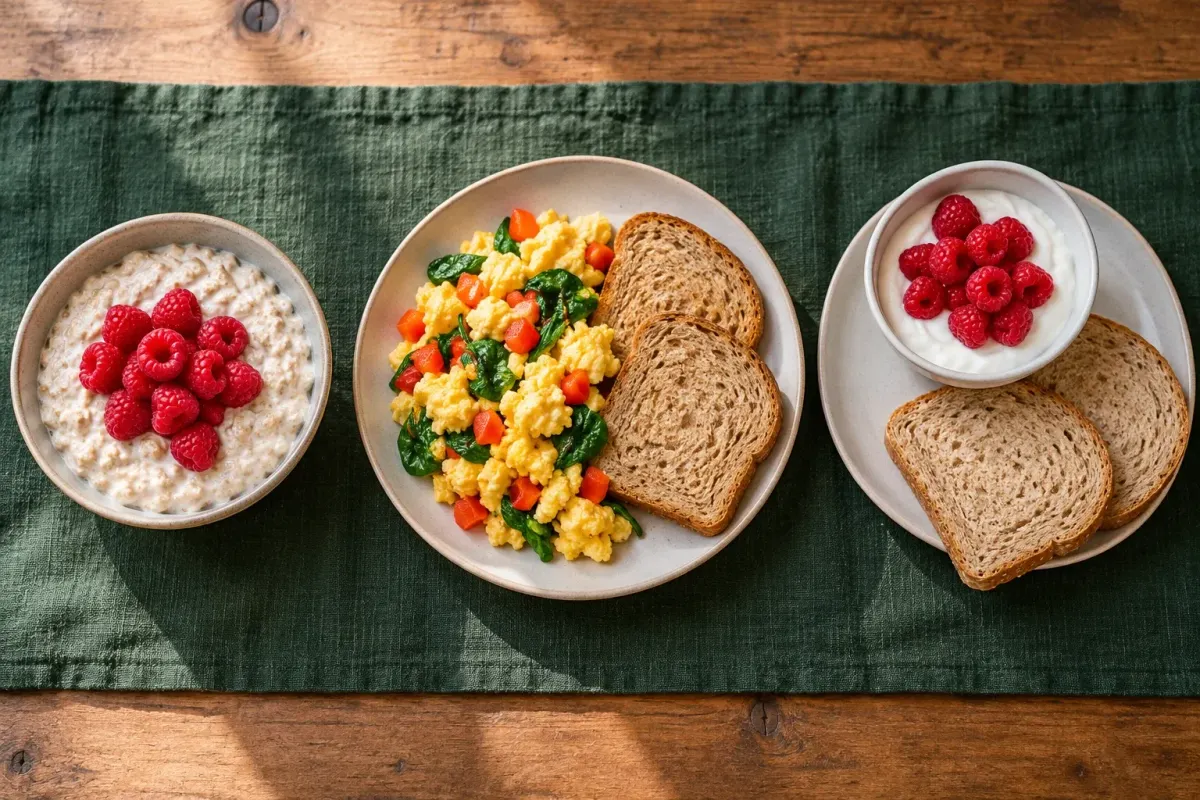
A protein and fiber breakfast can start with yogurt or eggs, whole grains, and produce. You do not need a new powder to make the three meals below. Start with an existing bowl or food-safe container, choose a format that fits your morning, and try one serving before stocking up.
Disclosure: This article contains affiliate links. We may earn a commission if you buy through them, at no extra cost to you.
The point is to make tomorrow’s breakfast easier to repeat. These are flexible meal templates, not a prescribed nutrient target or a claim that supplements are unnecessary for everyone.
Compare the three breakfasts, then use the shopping list to choose one for tomorrow. See the optional breakfast tools →
Compare the three breakfasts
Each breakfast makes one serving. Preparation times are planning estimates. Nutrition is described by its food sources; exact protein and fiber totals depend on the ingredients and portions you use. Oats, whole-grain bread, berries, and vegetables contribute fiber.[1] Yogurt contributes protein; check its label when choosing a product.[2]
Make-ahead bowl
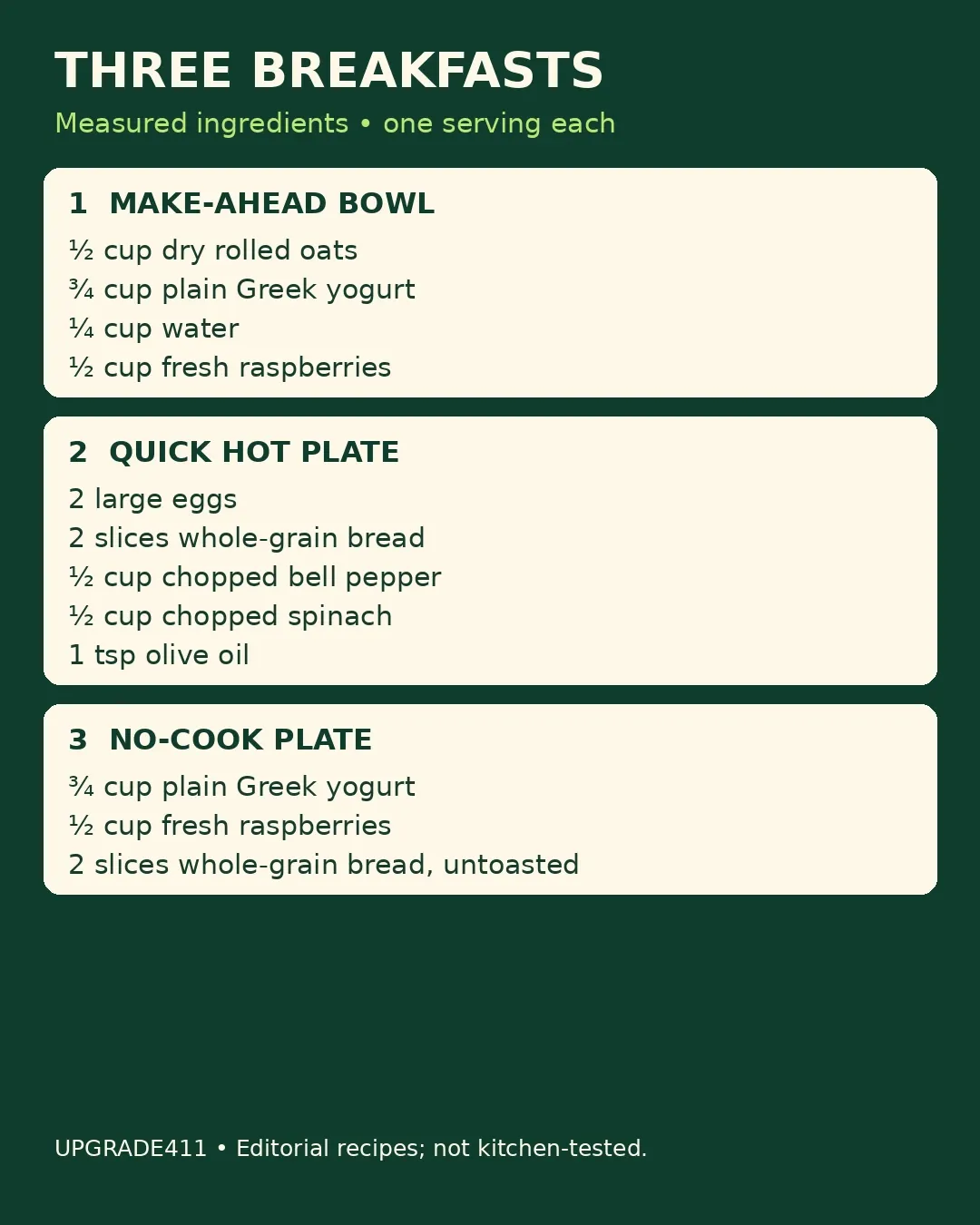
Exact ingredients for one serving: ½ cup dry rolled oats; ¾ cup plain Greek yogurt; ¼ cup water; ½ cup fresh raspberries
Protein and fiber sources: Yogurt / oats and raspberries
Active / total time, estimated: About 5 minutes / overnight, aiming for 8 hours of soaking
Ingredient cost per serving: Depends on your yogurt, oats and fruit prices
Portability: Pack cold in a lidded container
Dietary notes: Contains milk; check oats for gluten-related needs
Quick hot plate
Exact ingredients for one serving: 2 large eggs; 2 slices whole-grain bread; ½ cup chopped bell pepper; ½ cup chopped spinach; 1 tsp olive oil
Protein and fiber sources: Eggs / bread and vegetables
Active / total time, estimated: About 10–15 minutes / same
Ingredient cost per serving: Depends on egg, bread and produce prices
Portability: Easiest eaten at home; cooked components need safe cold packing if saved
Dietary notes: Contains egg and usually wheat; check bread for other allergens
No-cook plate
Exact ingredients for one serving: ¾ cup plain Greek yogurt; ½ cup fresh raspberries; 2 slices whole-grain bread, untoasted
Protein and fiber sources: Yogurt / fruit and bread
Active / total time, estimated: About 5 minutes / same
Ingredient cost per serving: Shares yogurt and fruit with the bowl
Portability: Pack yogurt and fruit cold; bread separately
Dietary notes: Contains milk and usually wheat; check bread label
To compare your own costs, multiply each package price by the fraction you use, then add the ingredients. Keep the cost of food eaten separate from the checkout total: buying a tub of yogurt costs more upfront than the fraction used in one meal. Include the oil in the hot plate’s calculation. None of these meals is established as the cheapest.
1. Make-ahead bowl: oats, yogurt and raspberries
Choose this when a few minutes tonight are easier to find than cooking time tomorrow.
For one serving: use the oat-bowl quantities in the comparison above. Optional: a pinch of cinnamon or 1 teaspoon chia seeds. Optional additions change the nutrition and cost.
- Stir the dry oats, yogurt and water together in a clean bowl or food-safe lidded container. Mix thoroughly so the oats are moistened.
- Rinse fresh raspberries under running water and add them, or keep them in a separate refrigerated container for the morning.[3]
- Cover and refrigerate immediately at 40°F or below. Let the oats soak overnight, aiming for 8 hours. Quaker’s overnight-oats guidance supports refrigerated soaking; this particular combination is an editorial recipe, not a tested manufacturer recipe.[3,4]
- In the morning, stir and add a little water if you prefer a looser texture. Eat this first trial serving the next morning; follow ingredient storage labels and do not use ingredients already beyond their recommended storage window.
The water adjusts consistency without introducing another required ingredient. If you add seeds, stir them into the wet mixture; skip them if you prefer fewer ingredients.
Dairy-free option: choose a plain alternative whose label shows protein in the amount you will actually eat. Do not assume almond, coconut, oat and soy products have identical nutrition. Texture may need a different amount of water.[2]
2. Quick hot plate: eggs, toast and vegetables
Choose this when you want something warm and can use a skillet. Set out the pan and bread first, and chop the vegetables before handling raw eggs.
For one serving: use the hot-plate quantities in the comparison above. Season to taste with pepper or dried herbs.
- Warm the oil in a skillet over medium heat. Add the bell pepper and cook, stirring, until softened to your preference.
- Add the spinach and stir until wilted. Beat the eggs in a separate bowl, then pour them into the skillet.
- Scramble until fully set, with no runny egg. FDA advises firm whites and yolks and non-runny scrambled eggs; egg dishes should reach 160°F, checked with a food thermometer.[5,6]
- Toast the bread while the eggs cook. Serve together immediately.
Egg-free option: replace the eggs with 150 g drained firm tofu. Crumble it into the vegetables and cook according to its package directions until heated through. This is a separate version: its protein, fiber, timing and cost must be calculated from the tofu you use, not copied from the egg version. It contains soy.
If saving cooked egg leftovers, refrigerate promptly in a shallow container, use within 3–4 days, and reheat to 165°F. A shorter ingredient-label limit takes priority.[3,5,6]
3. No-cook plate: yogurt, fruit and whole-grain bread
Choose this when you want to assemble breakfast without a stove or an overnight wait.
For one serving: use the no-cook quantities in the comparison above. Toasting the bread is optional and adds preparation time.
Spoon yogurt into a bowl, rinse and add the raspberries, and serve the bread alongside. For transport, pack the yogurt in a food-safe lidded container, the fruit separately if preferred, and the bread in its own bag or box. Keeping bread away from the wet ingredients helps preserve its texture.
Use an insulated bag with at least two cold sources for the yogurt and fruit, and refrigerate on arrival when possible. A divided container organizes food; it does not keep food safely cold by itself.[7]
Cracker option: replace the bread with 30 g whole-grain crackers. Compare the actual label; crackers are not automatically equivalent to two slices of bread in protein, fiber or cost.
Build a short grocery list
Pick two formats that share foods you already like. Here is a two-day example for one person, using one oat bowl on day one and one no-cook plate on day two:
| Ingredient | Day one: bowl | Day two: no-cook plate | Combined amount needed |
|---|---|---|---|
| Plain Greek yogurt | ¾ cup | ¾ cup | 1½ cups |
| Fresh raspberries | ½ cup | ½ cup | 1 cup |
| Dry rolled oats | ½ cup | — | ½ cup |
| Whole-grain bread | — | 2 slices | 2 slices |
| Water | ¼ cup | — | ¼ cup; no purchase needed |
Check the kitchen first, then buy enough to cover those amounts. Package sizes vary; this is the food needed for two breakfasts, not a promise that two servings consume every package you buy. Optional seeds and seasonings are excluded.
Make only the first bowl tonight. Assemble the no-cook plate on day two from ingredients stored according to their labels. This example is a shopping plan, not a seven-day refrigerator-storage recommendation.
Choose the tools that make your breakfast easier
A good breakfast kit solves a specific annoyance: a bowl that spills, fruit that gets mixed in too soon, a bag that is awkward to carry, or a scale display hidden under the bowl. Choose the job first, then compare the options below. You do not need the entire kit.
Upgrade411 may earn a commission from purchases made through links in this article. As an Amazon Associate I earn from qualifying purchases. These are researched product options, not products we have personally tested. Follow the instructions supplied with the exact item you buy.
Pack the oat bowl: one container or separate compartments?
Keep it simple: the OXO Prep & Go 3.3-Cup Container is a single-container option for someone who wants to mix, refrigerate and carry breakfast in one vessel. OXO specifies a gasket and locking clips. Check the portion fits with closing room, and follow the sealing instructions. This capacity is a starting point, not a tested fit for our recipe.
View OXO Prep & Go 3.3-Cup Container on Amazon →
Keep toppings separate: the OXO Prep & Go 4.1-Cup Divided Container has three compartments. Consider it when you prefer adding fruit at breakfast rather than soaking everything together. OXO describes separate lid gaskets; check compartment sizes before ordering. For the no-cook meal, bread may still need its own bag or box.
View OXO Prep & Go 4.1-Cup Divided Container on Amazon →
Choose one: a single container suits a mixed bowl; the divided version buys organization. If your existing container closes securely and holds the meal, keep using it.
Take breakfast to work: compare two carrying routines
Bag plus cold sources: the OXO Prep & Go Insulated Lunch Tote has an expandable main section and an outside pocket. It is worth considering if breakfast containers and utensils make your current bag awkward to close. Check dimensions against your container and cold sources before buying.
View OXO Prep & Go Insulated Lunch Tote on Amazon →
Freeze the bag overnight: the PackIt Freezable Classic Lunch Box uses cooling gel built into its walls. Freeze it overnight according to the instructions for the exact version you buy; freezing times can vary between versions. Consider it if you have freezer space and will remember that nightly step; choose a conventional insulated bag if you prefer handling separate ice packs.
View PackIt Freezable Classic Lunch Box on Amazon →
An insulated or frozen bag is not a promise that your meal stays safe for your whole commute. Follow the cold-packing guidance below, including at least two cold sources, and refrigerate on arrival when possible. We have not tested either bag with these meals.
Repeat weighted ingredients: basic scale or easier-to-see display?
Simple measuring option: the Etekcity EK6015 kitchen scale is a candidate for measuring the tofu or cracker variation. Its manufacturer page specifies a 5 kg/11 lb capacity. Follow the current instructions supplied with the exact scale you buy.
View Etekcity EK6015 kitchen scale on Amazon →
For a bowl that hides the numbers: the OXO 11 lb Stainless Steel Food Scale with Pull-Out Display lets the display move away from the platform. OXO specifies a zero function and 1 g metric increments. The buying reason is visibility around a larger bowl, not a claim that it makes the food healthier or measures more accurately than the other scale.
View OXO 11 lb Stainless Steel Food Scale with Pull-Out Display on Amazon →
Choose by the measuring problem you actually have. The bowl counts toward maximum load, even after tare; display increments are not a guarantee of accuracy. Measuring cups remain sufficient for the base breakfasts.
Check the hot breakfast: a thermometer with a clear job
The ThermoWorks ThermoPop 2 is an instant-read thermometer option for checking egg dishes and reheated leftovers against the temperatures in the recipe. The linked selection is Cayenne Pepper Red; confirm the probe length and variant on the product page before ordering. Follow its probe-placement instructions and avoid measuring the pan instead of the food.
View ThermoWorks ThermoPop 2 on Amazon →
This tool has a different job from a food scale: temperature rather than ingredient weight. If you already have a suitable working food thermometer, use it.
Build one useful kit, then stop
- Oat bowl at home: an existing bowl and cover may be enough.
- Oat bowl at work: choose one container, then a cold-carrying setup.
- No-cook breakfast at work: use a divided container or small separate containers, plus cold transport; keep bread dry.
- Hot breakfast: a suitable food thermometer helps check cooking or reheating temperatures.
- Weighted variations: add a scale only if you want to repeat those versions by weight.
Check the linked product page for the current price, chosen variant, availability and care instructions. Prices and shipping can change; the article does not promise a particular offer.
Preparation, storage and substitutions
Keep yogurt and prepared perishable meals refrigerated at 40°F or below. Refrigerate perishables within 2 hours, or 1 hour above 90°F. Time out of refrigeration includes preparation, transport and serving.[3] Overnight soaking does not extend an ingredient’s storage life; follow labels and plan small batches.
Check milk, egg, wheat and soy allergens, plus any others listed on packaged ingredients. If you need gluten-free meals, choose suitably labeled oats and bread or crackers; the substitution changes the comparison.
If adding fiber is a change for you, increase it gradually rather than adding several new toppings at once. NIDDK advises adding fiber a little at a time so your body can adjust.[1]
For a broader planning approach, read Don’t Meal-Prep Seven Days of Food: Use This Safer System. Use ingredient-specific guidance for these breakfasts.
Choose one breakfast for tomorrow
Use the combined shopping list, check what you have, and choose the format that fits your morning. After one serving, decide whether you like the texture, preparation and packing routine before scaling up.
If you want help adapting the list, copy this prompt:
Suggest two repeatable breakfast templates using these foods I enjoy: [list]. My restrictions are [list], preparation time is [minutes], and I need [at home / portable]. Give measured portions and a short combined shopping list. Do not prescribe a protein target or make health claims. Flag nutrition totals and storage questions for verification against food labels and official guidance.
Sources
- NIDDK: Eating, Diet, & Nutrition for Constipation — fiber-containing foods and gradual changes only; no constipation-treatment claim is made for these recipes.
- University of Florida IFAS Extension: Shopping for Health—Yogurt — yogurt nutrition and differences among products.
- FoodSafety.gov: 4 Steps to Food Safety — washing produce, refrigeration temperature and time limits, prompt cooling.
- Quaker: Overnight Oats — refrigerated soaking technique and 8-hour texture guidance; not a shelf-life validation or nutrition calculation for this recipe.
- FDA: What You Need to Know About Egg Safety — egg cooking, leftover storage and reheating.
- FoodSafety.gov: Safe Minimum Internal Temperatures — egg dishes 160°F and leftovers 165°F.
- USDA FSIS: Keeping Bag Lunches Safe — insulated packing and at least two cold sources; official indexed guidance retrieved, full-page access unavailable during this review.