How to Sleep Better Without Pills
Most people who struggle to fall asleep do the same thing: they climb into bed and wait for sleep to happen to them. Sleep does not work that way. It responds to systems — a repeatable sequence of cues that trains your body to shut down on schedule.

How to Sleep Better Without Pills
Most people who struggle to fall asleep do the same thing: they climb into bed and wait for sleep to happen to them. Sleep does not work that way. It responds to systems — a repeatable sequence of cues that trains your body to shut down on schedule.
Here is the good news: a deliberate wind-down protocol plus a properly set-up bedroom beats reaching for sleep aids, with zero grogginess the next morning. Below is the full system — the nightly routine, the sleep-cave environment, the timing anchor, and the saboteurs to remove.
This post contains affiliate links. If you purchase through our links, we may earn a commission at no extra cost to you. We only recommend products we've researched and would use ourselves.
The 60-Minute Wind-Down Protocol
Your brain needs a landing strip, not a cliff edge. A structured hour before bed signals your nervous system that the day is over. Run this sequence every night and your body will start winding itself down automatically within two weeks.
- Sixty minutes out: dim the house, park the screens. Bright overhead light suppresses melatonin, the hormone that opens the sleep gate. Switch to lamps, and put the phone on a charger outside the bedroom. If you must use a screen, kill the brightness — but parked is better.
- Forty-five minutes out: take a warm shower or bath. The magic is in what happens after: your core temperature drops as you cool down, which mimics the natural temperature decline your body uses to initiate sleep. It is one of the most underrated sleep hacks in existence.
- Thirty minutes out: go analog. Ten minutes of light stretching, a paperback, or a quick brain-dump journal entry. The rule is simple: nothing with a feed, a notification, or an argument attached.
- Ten minutes out: run the room check. Thermostat set, blinds closed, charger plugged in across the room, alarm set. One consistent final cue — same tea, same page of a book, same three deep breaths — becomes a Pavlovian trigger for sleepiness.
The exact activities matter less than the consistency of the sequence. Your brain is a pattern-matching machine; give it the same pattern nightly and it will start the shutdown process before you even reach the pillow.
Turn Your Bedroom Into a Sleep Cave
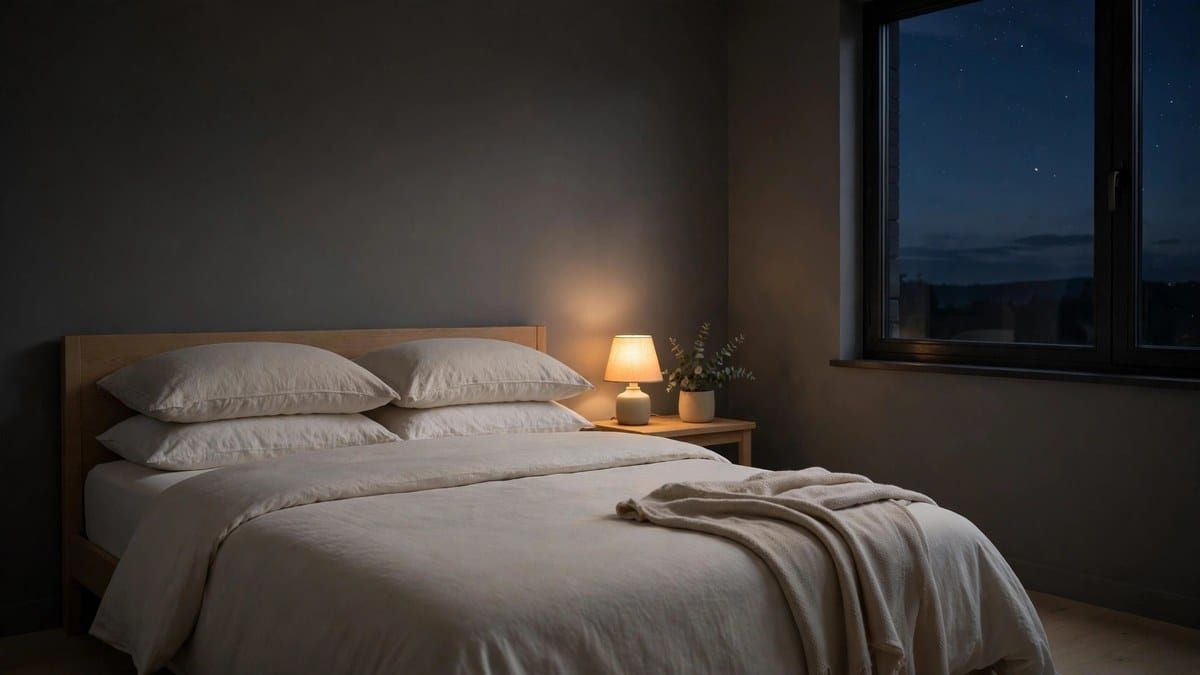
If your bedroom doubles as an office, a theater, and a scrolling den, your brain has no idea what the room is for. Reclaim it. The ideal sleep environment is cool, dark, and quiet — boring on purpose.
| Element | Target | Quick Fix |
|---|---|---|
| Temperature | Cool — around 65 to 68 degrees | Drop the thermostat; swap to a lighter blanket |
| Light | As dark as possible | Blackout curtains; tape over standby LEDs |
| Sound | Steady and low | A fan or white-noise app masks variable noise |
| Pillow | Right height for your sleep position | Upgrade the pillow first — the cheapest fix |
Start with the pillow, because it is the single highest-leverage, lowest-cost upgrade in the room. Side sleepers need loft; back sleepers need less. A memory-foam option that fits your position — like the Premium Memory Foam Pillow — removes one more reason to toss and turn. Check current price before you buy.
Light deserves special attention: even small sources — a router LED, a glowing power strip — measurably fragment sleep. If you cannot make the room pitch black, a comfortable sleep mask does the job for a few dollars.
Lock In Your Wake Time
Here is the part most sleep advice gets backwards: the wake time matters more than the bedtime. A fixed wake time anchors your entire circadian rhythm. When the anchor holds, bedtime sleepiness arrives on its own.
- Pick one wake time and hold it seven days a week. Yes, weekends too. A two-hour weekend lie-in can shift your rhythm as much as flying across time zones — researchers call it social jet lag.
- Get daylight within an hour of waking. Step outside or sit near a bright window. Morning light is the strongest signal that sets your clock; it tells your body when to start the countdown to tonight's melatonin release.
- If you miss your bedtime, still hit your wake time. One short night followed by a normal schedule corrects itself. Sleeping in to "catch up" just moves the problem to tomorrow.
If you are not sure whether you are actually holding the schedule, a tracker that logs your sleep score and wake times makes the pattern visible. And if a clock change has your timing scrambled, we built a separate week-long plan for the fall time-change transition — but the system in this article is what keeps you sleeping well the other fifty-one weeks of the year.
Evict the Evening Saboteurs
No wind-down protocol survives these four. Audit your evenings honestly:
- Caffeine after 2 p.m. Its half-life is five to six hours, so a 3 p.m. coffee is still half-strength at 9 p.m. Move your last cup before lunch and the wind-down gets dramatically easier.
- The "nightcap." Alcohol sedates you, then fragments your sleep architecture in the second half of the night — lighter sleep, more wakeups, groggier morning. It borrows sleep from your future self at terrible interest rates.
- Screens in bed. It is not just the blue light; it is the engagement. An argument in the comments section is the opposite of a wind-down cue.
- Hard workouts within two hours of bed. Morning or afternoon exercise deepens sleep. Late-evening intensity raises core temperature and adrenaline at exactly the wrong time. If evenings are your only window, keep it gentle: a walk, stretching, yoga.
Our Top Picks
Hatch Restore 2 Sunrise Alarm Clock
A sunrise alarm, sound machine, and bedtime routine in one. The gradually brightening light mimics a natural dawn so you wake gently, and the guided wind-down routines replace late-night scrolling with something your nervous system actually wants. Dimmable display keeps the room dark overnight. Check the current price on Amazon.
Premium Memory Foam Pillow
The cheapest meaningful upgrade in your bedroom. Supportive memory foam that holds its shape night after night, so your neck and spine stay aligned instead of negotiating with a flat pancake. If you wake up with a stiff neck, start here before you blame your mattress. Check the current price on Amazon.
Fitbit Charge 6
Tracks your sleep score, sleep stages, and wake times automatically, so you can see whether your new routine is actually working. The consistency data is the real feature: if your wake time is drifting on weekends, you will catch it in the app instead of feeling it at 2 a.m. Also covers heart rate, SpO2, and 40-plus exercise modes. Check the current price on Amazon.
The Bottom Line
Better sleep is not a pill — it is a protocol. Run the same sixty-minute wind-down every night, make your bedroom cool, dark, and quiet, anchor one wake time seven days a week, and evict caffeine, nightcaps, and bedtime scrolling from your evenings. Give the system two weeks and your body will start doing most of the work for you.
Start tonight with the easiest win: set your wake time, dim the lights an hour before bed, and browse the top picks above to fix whatever your bedroom is missing. Your tomorrow-morning self will thank you.