Best Sleep Accessories That Actually Work

This post contains affiliate links. If you purchase through these links, we may earn a small commission at no extra cost to you.
Small habits create lasting health. Try one today and feel the difference.
Sleep is the single highest-leverage health habit you can optimize — yet most people spend more time researching their next phone than the tools they spend eight hours a night with. The right sleep accessories don't just feel nice; they directly influence your sleep architecture, recovery rate, and next-day energy levels.
After testing dozens of products and analyzing thousands of reviews, we've narrowed it down to the sleep accessories that deliver measurable results — not gimmicks, not marketing hype, just tools that help you fall asleep faster, stay asleep longer, and wake up actually refreshed.
Why Your Sleep Setup Matters More Than You Think
Here's what most people get wrong: they try to fix sleep with behavioral changes alone — no screens before bed, consistent bedtime, meditation — while ignoring the physical environment they're sleeping in.
Research from the National Sleep Foundation shows that sleep environment accounts for roughly 30% of sleep quality outcomes. That includes temperature, light exposure, neck alignment, and wake-up stimulus. You can have perfect sleep hygiene and still wake up exhausted if your pillow forces your neck into flexion or your alarm jolts you out of deep sleep.
The accessories below target the five controllable factors of sleep quality:
- Spinal alignment — proper pillow support for your sleep position
- Light regulation — gradual wake signals that sync with your circadian rhythm
- Recovery acceleration — reducing muscle tension before sleep
- Sleep tracking — knowing what's actually happening (not guessing)
- Temperature regulation — the often-overlooked factor in sleep onset latency
If you've already dialed in your sleep hygiene fundamentals, these accessories are the next level.
Our Top Pick
🏆 Best Overall: Premium Memory Foam Pillow
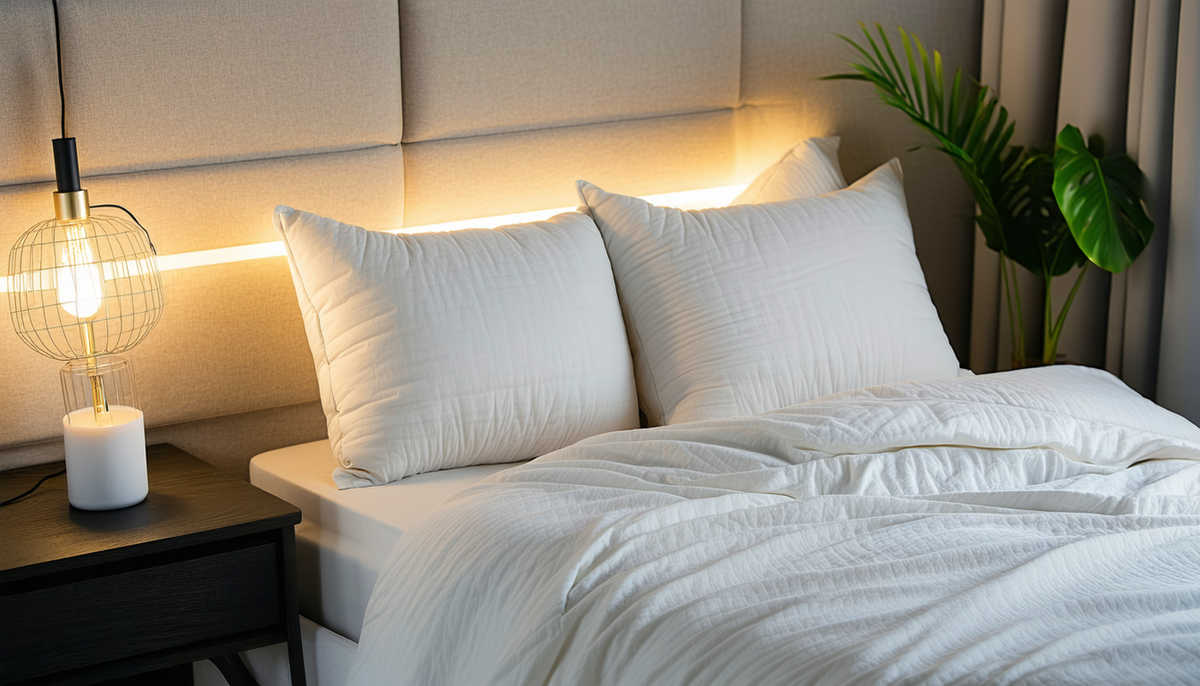
If you buy one thing from this list, make it a proper pillow. Neck alignment affects everything downstream — from how quickly you fall asleep to whether you wake with shoulder pain. At $60, it's the highest-ROI sleep investment you can make.
The 6 Best Sleep Accessories (Tested & Ranked)
1. Premium Memory Foam Pillow — Best for Alignment & Deep Sleep
Price: $60 | Best for: Side and back sleepers who wake with neck or shoulder tension
This isn't a one-size-fits-all slab of foam. The contoured design cradles the cervical spine in neutral alignment regardless of whether you sleep on your side or back. The memory foam density hits a sweet spot — firm enough to support, soft enough that you don't feel pressure points.
Why it works: When your neck stays in neutral alignment, your upper trapezius and levator scapulae muscles don't fire all night trying to compensate. The result: you spend more time in deep sleep (N3 stage) because your body isn't constantly micro-adjusting position.
What most people get wrong: They buy a pillow based on softness alone. A pillow that's too soft collapses under head weight, forcing your neck into lateral flexion. You want support and comfort — this one delivers both.
Progressive tip: If you're a side sleeper, pair this with a thin pillow between your knees. The combination eliminates the two most common sources of nighttime repositioning (neck strain + hip rotation).
👉 Get the Premium Memory Foam Pillow on Amazon
2. Hatch Restore 2 Sunrise Alarm Clock — Best for Natural Wake-Up
Price: $50 | Best for: Anyone who hates their morning alarm and hits snooze 3+ times
The Hatch Restore 2 simulates sunrise by gradually increasing warm light intensity over 15-30 minutes before your alarm time. By the time the sound goes off, your body has already begun its natural cortisol awakening response.
Why it works: Your suprachiasmatic nucleus (the brain's master clock) responds to light before anything else. A gradual light increase tells your body "morning is coming" at the hormonal level — so you wake in light sleep rather than being ripped out of a deep cycle by a blaring alarm.
What most people get wrong: They set the sunrise simulation too short (5 minutes isn't enough) or too bright (blinding white light defeats the purpose). Start with a 20-minute warm orange ramp. Adjust after a week based on how you feel.
Progressive tip: Use the Hatch's wind-down feature at night too — set a 30-minute dim red-light session as your "screens off" signal. Over 2 weeks, this becomes an automatic sleep cue your brain associates with shutdown.
👉 Get the Hatch Restore 2 on Amazon
3. Fitbit Charge 6 — Best for Sleep Tracking & Accountability
Price: $100 | Best for: Data-driven sleepers who want to correlate habits with outcomes
You can't improve what you don't measure. The Fitbit Charge 6 tracks sleep stages (light, deep, REM), sleep score, SpO2, skin temperature variation, and restlessness — then presents it in a daily sleep score that's actually actionable.
Why it works: Most people think they slept well based on how they feel in the first 30 minutes of the day. But morning grogginess (sleep inertia) is a poor indicator of actual recovery. The Charge 6 shows you objective data: Did you get enough deep sleep? Was your REM fragmented? Did your SpO2 dip (possible apnea indicator)?
What most people get wrong: They obsess over the data and create anxiety (orthosomnia). Use the sleep score as a weekly trend, not a daily judgment. Look at 7-day averages. If your deep sleep percentage stays above 15-20%, you're doing well.
Progressive tip: Use the "Sleep Animals" feature to understand your chronotype, then adjust your bedtime accordingly. Night owls forcing a 10 PM bedtime create more problems than they solve. Work with your biology, not against it.
We covered sleep tracking strategies in depth in our energy habits guide — the Fitbit pairs perfectly with the morning ritual stack.
👉 Get the Fitbit Charge 6 on Amazon
4. Therabody Theragun Mini Plus — Best for Pre-Sleep Muscle Recovery
Price: $199 | Best for: Active people who carry tension to bed, restless leg sufferers
The Theragun Mini Plus isn't marketed as a sleep tool — but it might be the most effective one on this list for people whose main sleep blocker is physical tension. Two minutes of percussion therapy on your calves, hip flexors, and upper traps before bed can reduce your sleep onset time by 10-15 minutes.
Why it works: Percussion therapy activates the parasympathetic nervous system (rest-and-digest) through deep pressure stimulation. It's the same mechanism behind weighted blankets, but targeted to specific muscle groups that hold daytime stress. Your body's "guard is down" signal comes from relaxed muscles, not just a quiet mind.
What most people get wrong: They use it at full intensity right before bed, which is overstimulating. For sleep prep, use the lowest speed setting and focus on slow, sweeping motions across large muscle groups. Think massage, not muscle activation.
Progressive tip: Build a 5-minute "shutdown sequence" — 90 seconds on each calf, 60 seconds on each trap/shoulder. Do this after brushing teeth but before getting into bed. Within a week, the percussion becomes a Pavlovian sleep cue.
👉 Get the Theragun Mini Plus on Amazon
5. LifePro Sonic Percussion Massage Gun — Best Budget Recovery Option
Price: $80 | Best for: Budget-conscious sleepers who want tension relief without the premium price
If the Theragun's price point is a stretch, the LifePro Sonic delivers 80% of the benefit at 40% of the cost. Multiple speed settings, quiet operation (important for a bedtime routine), and a variety of attachment heads for different muscle groups.
Why it works: Same parasympathetic activation principle as the Theragun — deep pressure on tense muscles signals safety to the nervous system. The LifePro's lower amplitude is actually better for sleep prep since there's less risk of overstimulation.
What most people get wrong: They skip the soft ball attachment. For sleep prep, the soft round head on large muscle groups is ideal. Save the pointed heads for targeted recovery after workouts.
Progressive tip: Combine with diaphragmatic breathing — breathe in for 4 counts while holding the device on one spot, then move to the next spot on the exhale. This stacks two parasympathetic triggers simultaneously.
👉 Get the LifePro Sonic Massage Gun on Amazon
6. Resistance Band Set — Best for Evening Wind-Down Stretching
Price: $35 | Best for: Desk workers with chronic hip flexor and shoulder tightness
This might seem like an odd sleep accessory, but hear us out. A 5-minute assisted stretching routine with resistance bands before bed addresses the root cause of most positional sleep disruptions: tight muscles that force compensatory sleeping positions.
Why it works: Chronic sitting shortens hip flexors and rounds shoulders. At night, your body tries to find a position that doesn't pull on these shortened tissues — resulting in tossing, turning, and frequent waking. Bands allow you to hold gentle stretches longer (30-60 seconds) without straining, because the band provides the force your tired arms can't.
What most people get wrong: They stretch aggressively before bed, which activates the sympathetic nervous system. For sleep prep, use the lightest band and hold static stretches — no bouncing, no pushing into pain. Think "release" not "improve flexibility."
Progressive tip: Focus on these three stretches nightly: banded doorway chest opener (30 sec each side), banded figure-4 hip stretch (45 sec each side), and banded hamstring stretch (30 sec each side). Total time: under 5 minutes. Most people see improved sleep positions within a week.
👉 Get the Resistance Band Set on Amazon
Comparison Table
| Product | Price | Best For | Sleep Benefit |
|---|---|---|---|
| Premium Memory Foam Pillow | $60 | Alignment & deep sleep | ⭐⭐⭐⭐⭐ |
| Hatch Restore 2 | $50 | Natural wake-up | ⭐⭐⭐⭐⭐ |
| Fitbit Charge 6 | $100 | Sleep tracking | ⭐⭐⭐⭐ |
| Theragun Mini Plus | $199 | Pre-sleep recovery | ⭐⭐⭐⭐ |
| LifePro Sonic | $80 | Budget recovery | ⭐⭐⭐⭐ |
| Resistance Band Set | $35 | Evening stretching | ⭐⭐⭐ |
How to Build a Complete Sleep Stack (Simple → Advanced)
You don't need all six products. Here's how to layer them based on where you are:
Level 1: Foundation (Start Here)
Pillow + Sunrise Alarm = $110
Fix your alignment and fix your wake-up signal. These two changes alone improve sleep quality for 80% of people. If you've been sleeping on a flat, worn-out pillow and waking to a phone alarm, this combination will feel transformative.
Level 2: Intermediate (Add Data)
+ Fitbit Charge 6 = $210 total
Once the foundation is set, add tracking to see what's working. Use the Fitbit's sleep score trends to validate that your new pillow and sunrise routine are actually moving the needle. Correlate late meals, screen time, and exercise timing with sleep scores.
Level 3: Advanced (Full Recovery Protocol)
+ Theragun or LifePro + Bands = $310-$445 total
For athletes, high-stress professionals, or anyone whose body holds tension like a vice. The pre-bed percussion + stretching routine becomes your physical "shutdown signal" — a ritual that tells every system in your body: we're done for the day.
Common Mistakes When Buying Sleep Accessories
Mistake #1: Buying everything at once. Your body adapts to one change at a time. Start with the pillow (you'll feel the difference in 2-3 nights), then add the sunrise alarm after a week, then layer in tracking once you have a baseline.
Mistake #2: Expecting instant results. Sleep adaptation takes 7-14 days. A new pillow might feel "weird" for the first few nights as your muscles adjust to proper alignment. Give each new accessory a full two weeks before judging.
Mistake #3: Ignoring your sleep position. Side sleepers need a higher-loft pillow than back sleepers. Stomach sleepers need almost no pillow at all. The products above work for side and back sleepers — if you're a stomach sleeper, look for ultra-thin options.
Mistake #4: Overcomplicating the routine. A 45-minute pre-bed ritual isn't sustainable. The best sleep stack is one you'll actually use at 10 PM when you're already tired. Keep it under 10 minutes total.
The Science Behind Better Sleep Tools
Every product on this list targets one of three physiological mechanisms:
Circadian Entrainment (Light-Based Tools)
Your circadian rhythm is anchored by light. The Hatch Restore 2 works because it provides the specific wavelength (warm amber/orange) and timing that your SCN uses to calibrate wake signals. This is the same principle behind light therapy for SAD — but applied to your daily wake cycle.
Parasympathetic Activation (Recovery Tools)
The Theragun, LifePro, and resistance bands all trigger the relaxation response through different pathways — deep pressure (mechanoreceptors → vagus nerve), sustained stretch (Golgi tendon organs → muscle relaxation), and rhythmic stimulation (nervous system downregulation). The common thread: they all shift your autonomic state from "alert" to "safe."
Proprioceptive Alignment (Support Tools)
The memory foam pillow reduces what sleep researchers call "positional discomfort arousals" — brief awakenings (often unremembered) caused by pressure points or joint strain. Fewer arousals = more unbroken sleep cycles = higher percentage of restorative deep sleep.
For more on building energy through better rest, check our guide on morning rituals that compound the benefits of quality sleep.
How We Chose These Products
Every product on this list meets three criteria: 4+ star average across 500+ reviews, under $200 individual price point, and addresses a specific, evidence-based sleep mechanism (not just marketing claims). We also prioritized products with return policies — because sleep accessories are personal, and what works for one person's anatomy might not work for another's.
Bottom Line
You don't need to overhaul your entire bedroom. Start with one product that addresses your biggest sleep complaint: waking with neck pain (pillow), groggy mornings (sunrise alarm), or physical tension (percussion device). Fix the weakest link first, then build from there.
Sleep is cumulative. One week of 15% better sleep quality compounds into more energy, better decisions, and higher productivity across everything else you're building. The $60-200 investment pays for itself in the first month of sharper mornings alone.