How to Build Daily Habits That Actually Stick: The Science-Backed System for 2026

Why Most Habits Fail (And What the Science Says Instead)
Here's the uncomfortable truth about habit building: motivation isn't the problem. Research published in Psychology & Health shows that 65% of daily behaviors are triggered automatically by routine structure — not willpower, not motivation, not discipline.
Yet most people try to build habits by "trying harder." They set ambitious goals on January 1st, white-knuckle through two weeks, then crash. The problem isn't them — it's the approach.
Behavioral scientists have spent decades studying what actually makes habits stick. The answer isn't sexy, but it works: redesign the cue, reduce the friction, and make the reward immediate. This post breaks down exactly how to do that — with specific tools, techniques, and a progressive system you can start today.
The Habit Loop: Understanding How Your Brain Automates Behavior
The Three Components
Every habit follows the same neurological pattern, called the habit loop:
- Cue — the trigger that initiates the behavior (a time, location, emotion, or preceding action)
- Routine — the behavior itself (what you actually do)
- Reward — the benefit your brain receives (dopamine hit, relief, satisfaction)
The key insight: your brain doesn't distinguish between good and bad habits. It automates anything that follows this loop consistently. The goal isn't to fight your brain's automation system — it's to use it deliberately.
Why 66 Days Matters (Not 21)
You've probably heard it takes 21 days to form a habit. That's a myth from a 1960s plastic surgery study — it has nothing to do with behavioral science. The actual research (Phillippa Lally, University College London, 2009) found that habits take an average of 66 days to become automatic — with a range of 18 to 254 days depending on complexity.
What this means for you: Don't judge a habit at day 14. The real question isn't "do I feel motivated?" — it's "am I still doing it?" Consistency beats intensity every time.
The Four Laws of Behavior Change
James Clear's framework (from Atomic Habits) distills behavioral science into four actionable principles. Here's how to apply each one:
Law 1: Make It Obvious (Cue Design)
If you don't notice the cue, the habit won't fire. Strategies:
- Implementation intention: "I will [BEHAVIOR] at [TIME] in [LOCATION]." Example: "I will journal at 7:00 AM at my kitchen table."
- Habit stacking: "After I [CURRENT HABIT], I will [NEW HABIT]." Example: "After I pour my morning coffee, I will write one gratitude entry."
- Environment design: Put your journal on the kitchen table the night before. Put your running shoes by the front door. Make the cue impossible to miss.
Law 2: Make It Attractive (Craving)
Your brain pursues behaviors that feel rewarding to anticipate. Strategies:
- Temptation bundling: Pair a habit you need to do with something you want to do. Example: Listen to your favorite podcast only while walking.
- Join a group where the behavior is normal. If everyone around you journals, journaling feels natural — not effortful.
- Reframe the language: "I get to meditate" not "I have to meditate." This sounds small, but it shifts the behavior from obligation to opportunity.
Law 3: Make It Easy (Reduce Friction)
The most important law for beginners. Strategies:
- The 2-Minute Rule: Scale every new habit down to 2 minutes or less. "Read 30 pages" becomes "read one paragraph." "Run 3 miles" becomes "put on running shoes." You can always do more — but the minimum is 2 minutes.
- Reduce steps: Every extra step between you and the behavior is friction. Lay out your workout clothes the night before. Keep your journal open on your desk. Pre-fill your water bottle.
- Optimize the environment: Want to eat healthier? Put fruit on the counter, hide the chips in a cabinet. The behavior that requires the least effort wins.
Law 4: Make It Satisfying (Immediate Reward)
The brain prioritizes immediate rewards over delayed ones. Strategies:
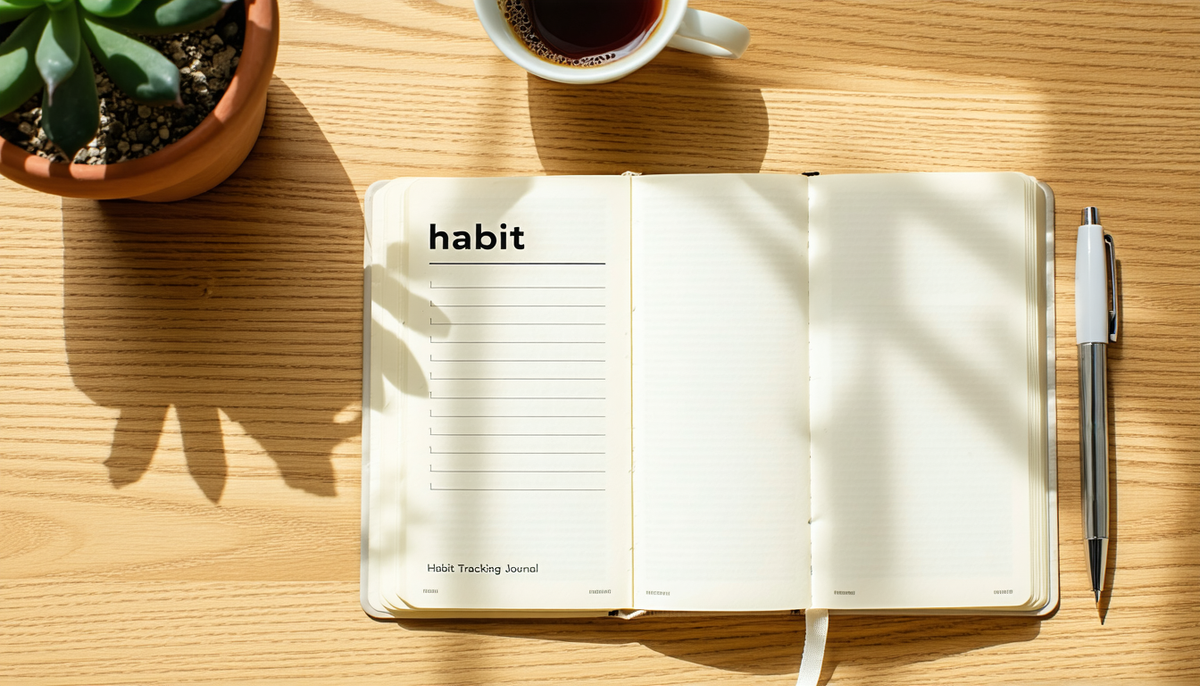
- Habit tracking: The visual satisfaction of checking off a box or maintaining a streak is an immediate reward. This is why habit journals work — they make progress visible.
- Never miss twice: Missing once is an accident. Missing twice is the start of a new (bad) habit. If you miss a day, the only rule is: get back the next day.
- Reward yourself: After completing your habit, do something small that feels good. The key: the reward must come immediately, not at the end of a month.
Habit Stacking: The Most Underrated Technique
How It Works
Habit stacking leverages an existing neural pathway (your current habit) as the cue for a new one. Your brain already fires automatically for the old habit — you're just attaching a new behavior to that same signal.
The Formula
"After I [CURRENT HABIT], I will [NEW HABIT]."
Real Examples That Work
- After I pour my morning coffee → I will write down 3 things I'm grateful for
- After I sit down at my desk → I will write my top 3 priorities for the day
- After I finish dinner → I will read for 10 minutes
- After I brush my teeth at night → I will meditate for 2 minutes
- After I close my laptop for the day → I will journal for 5 minutes
Why It Beats "I'll Do It at 7:00 AM"
Time-based cues are weak because your schedule varies. Action-based cues are stronger because you're attaching to something you already do reliably. "After my coffee" happens every day regardless of what time you wake up.
Common Mistakes That Kill Habits
Mistake #1: Starting Too Big
If your new habit requires 30+ minutes of willpower, it's too big for day one. The research is clear: small habits compound into large ones, but large habits collapse into nothing. Start with 2 minutes. Scale up only after the behavior is automatic (2+ weeks of consistency).
Mistake #2: Relying on Motivation
Motivation fluctuates — it's an emotion, not a strategy. Systems work when motivation doesn't. That's the entire point of environment design and habit stacking: they remove motivation from the equation.
Mistake #3: Tracking Too Many Habits at Once
Your brain can only automate 1–3 new behaviors simultaneously. If you're tracking 10 habits, you're diluting your focus and draining willpower on all of them. Pick 1–2 habits maximum. Add more only after these are fully automatic (4–8 weeks).
Mistake #4: No Visual Accountability
What gets measured gets managed. Without a visible tracking system (paper journal, app, calendar), habits live in your head — where they're easy to forget, rationalize, or skip. The streak itself becomes the reward.
Mistake #5: Punishing Yourself for Missing
Guilt doesn't build habits. Missing a day doesn't erase your progress — it's just a data point. The only rule: never miss twice. One miss is an accident. Two misses is the beginning of a new pattern.
The Tools: Habit Journals & Trackers That Work
Why Paper Beats Apps (For Most People)
Research in r/habitrpg and behavioral science forums consistently shows that paper-based trackers create more lasting behavior change than digital alternatives. Why? The physical act of writing engages different neural pathways than tapping a screen. It's slower, more deliberate, and harder to ignore.
That said, the best system is the one you'll actually use. Here are options across formats:
Best Habit Tracking Journals
- Mantra Planner 2026 (Daily Journal + Habit Tracker + Gratitude) — $25 | Combines daily planning, habit tracking, and gratitude prompts in one system. 4.4 stars, 194 reviews. Best for people who want structure without complexity.
- The Habit Tracker Journal (Bullet Journaling for Beginners) — $14 | Pure habit tracking with a visual streak system. No fluff, no extra prompts — just daily checkboxes and monthly reviews. Best for minimalists.
- Atomic Habits Clear Habit Journal — $18 | Designed as a companion to the book. Includes implementation intention prompts, habit stacking templates, and reflection pages. Best if you've read Atomic Habits and want to apply it.
Best Self-Improvement Books on Habits
- Atomic Habits by James Clear — $13 | The definitive modern guide to habit formation. Read this first — everything in this post builds on its framework.
- Tiny Habits by BJ Fogg — $15 | Stanford behavioral scientist's system. Focuses on making habits absurdly small to eliminate friction. More academic than Atomic Habits, equally practical.
The Progressive System: Beginner → Intermediate → Advanced
Level 1: The Starter Stack (Week 1–2)
Pick ONE habit. Make it 2 minutes or less. Attach it to an existing behavior using habit stacking. Track it daily (paper or app). Your only goal: don't break the streak.
Example: "After I pour my morning coffee, I will write one sentence in my journal."
Level 2: The Expansion (Week 3–6)
Once your starter habit is consistent (14+ days in a row), do two things:
- Gradually increase the duration (2 minutes → 5 minutes → 10 minutes)
- Add ONE more habit using the same stacking technique
Example: Morning coffee → journal for 5 minutes. After journaling → review today's 3 priorities (2 minutes).
Level 3: The System (Week 7+)
Build a morning stack and an evening stack — 3–4 habits chained together, each triggered by the previous one. At this stage, you're not relying on willpower at all. The behaviors fire in sequence like dominoes.
Example morning stack:
- Wake up → make coffee (existing habit)
- After pouring coffee → write 3 gratitudes (2 min)
- After gratitude → review daily priorities (2 min)
- After priorities → 5-minute meditation
Total added time: ~10 minutes. Total behaviors automated: 3 new habits. No willpower required after ~8 weeks.
Try This Today: Your 5-Minute Setup
- Pick one habit you want to build (keep it small — 2 minutes max)
- Choose your anchor: What existing habit will trigger it? (morning coffee, brushing teeth, sitting at desk, getting into bed)
- Write the formula: "After I [anchor], I will [new habit] for 2 minutes."
- Set up tracking: Put a journal on your desk, mark a calendar on the wall, or open a habit app. Make the streak visible.
- Do it right now. Not tomorrow. The first rep is the hardest — and the most important.
That's it. No 30-day challenge, no complex system, no $200 productivity course. Just one tiny behavior, attached to something you already do, tracked where you can see it. The compounding starts today.
Related reads on UPGRADE411:
- Best Electrolyte Powders for Summer 2026
- Sleep & Recovery Optimization: What Actually Works
- Morning Routines That Actually Boost Productivity
Disclosure: UPGRADE411 may earn a commission on purchases made through links in this article. We only recommend products we've researched and would use ourselves.